
Date of birth: 24 June 1987
Birthplace: Rosario, Argentina
Playing role: Forward and playmaker
Senior clubs: Barcelona, Paris Saint-Germain and Inter Miami
Current club: Inter Miami, as of 10 September 2026
Argentina status: Retired from international football; announced 31 August 2026
Lionel Messi is an Argentine forward and playmaker whose close control, inventive passing and wonderfully varied goals have made him a favourite with football fans around the world. Whether you first watched him combining with Ronaldinho at Barcelona or curling in a free-kick for Inter Miami, much of the pleasure is the same: he can find an opening just when a defence appears to have closed every route to goal.
The Argentine forward has given football fans plenty of occasions to enjoy that feeling. His Barcelona career brought 672 goals in 778 official appearances, while his eight Ballon d’Or awards recognise a remarkable span of individual achievement. Then there is Argentina’s 2022 World Cup victory, the success that finally allowed him to lift the trophy he had spent so many years pursuing.
Yet the story becomes even more interesting when you look beyond the medals. There is a grandmother who encouraged a little boy to play, a teenager learning to live far from home, and an established star who still speaks fondly about having fun in training. To get to know Lionel Messi properly, we need to begin with the family and football pitches of Rosario.
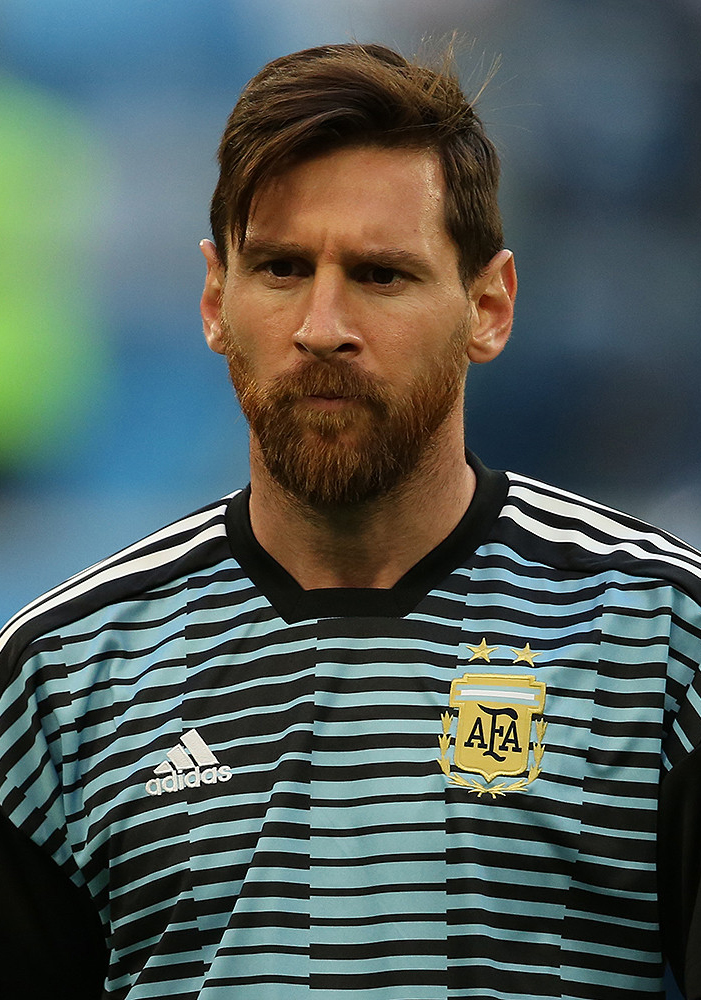
 Lionel Messi (middle) with Julian Alvarez (left) and Angel Di Maria (right) during the 2022 FIFA World Cup Match 24, Argentina v Mexico. Attribution: Tasnim News Agency via Wikimedia Commons
Lionel Messi’s early life
Lionel Messi was born on 24 June 1987 in Rosario, the Argentine city where he first played organised football. He grew up in the working-class neighbourhood of La Bajada with his parents, Jorge and Celia, and siblings Rodrigo, Matías and María Sol. Jorge worked in the steel industry, and football ran through family life. As Sports Illustrated’s June 2010 profile describes, the games involved his older brothers and a young Leo whose enthusiasm for a ball did not conveniently stop at the front door.
His first local club was Grandoli, where Jorge coached. But Messi also credits his grandmother, Celia, with helping him get onto the pitch. Recalling those days in a May 2021 Olé interview reported by TyC Sports, he described a match in which a player was missing. His grandmother urged the coach to let him take part, despite concerns about his small size. Her encouragement had helped turn a visit to the local club into a chance to play.
From Grandoli he joined the youth ranks of Newell’s Old Boys. Now there was a bigger football setting in which to develop, although something important was happening away from the matches too. Messi was growing more slowly than expected. His endocrinologist, Diego Schwarzstein, later explained that he first saw him in 1997, when Leo was nine, and diagnosed growth hormone deficiency. Treatment involved regular hormone injections to address that medical condition, as Schwarzstein recalled in a July 2017 interview with Rosario Plus.
The practical question of paying for treatment became part of the family’s decisions. Accounts differ over how much support Newell’s provided, but the concern about meeting the cost is clear in the family reporting in Sports Illustrated. Barcelona’s willingness to support his treatment would help make a move possible. For Leo, that opportunity meant leaving the place, people and club he already knew.
Messi travelled to Barcelona for a trial in 2000, aged 13. You may have heard that his first contract was written on a napkin. The story has a real object at its heart, although the detail matters: on 14 December 2000, Carles Rexach wrote a commitment to sign him during a meeting with intermediaries Josep Minguella and Horacio Gaggioli at the Pompeia tennis club. It was a written promise to secure the youngster, rather than a complete playing contract signed by Messi. Sid Lowe’s account for Bonhams explains the circumstances behind that unusually modest piece of football history.
Moving countries did not immediately turn life into a celebration. There were registration delays and an injury, which Messi remembered when looking back with Olé in May 2021. His mother and siblings eventually returned to Argentina, while he stayed with his father. Explaining the choice in his May 2016 account for TIME, as told to Grant Wahl, Messi said: “I chose to stay in Barcelona because I saw I would have chances there.” The opportunity was exciting, but taking it also meant accepting a difficult separation.
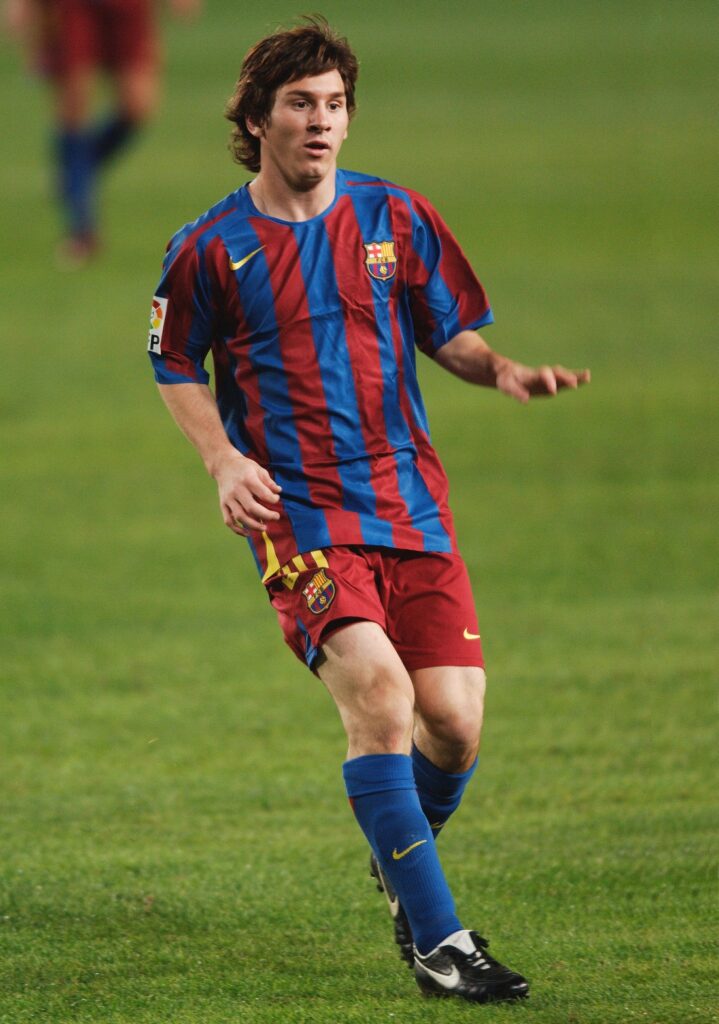 Lionel Messi playing for F.C. Barcelona during a match against Málaga on October 26, 2005. Attribution: Josep Tomas via Wikimedia Commons
Finding his feet at Barcelona
Barcelona’s youth teams gave Messi both a football education and a new group of companions. Among the players of his generation were Cesc Fàbregas and Gerard Piqué. The FourFourTwo feature on Barcelona’s generation of 1987, published in March 2018, includes a rather endearing memory from teammate Julio de Dios: the youngsters held PlayStation tournaments, and Messi initially struggled at the video game. On an actual football pitch, however, his ability was another matter entirely.
There is something reassuringly ordinary about that picture of a gifted teenager. He was building friendships, adjusting to his surroundings and finding his place in a team. The senior opportunities followed. Messi appeared in a first-team friendly against Porto during the 2003/04 season, aged 16, before Frank Rijkaard gave him his competitive debut against Espanyol on 16 October 2004. Barcelona won 1–0.
His first official goal arrived against Albacete at Camp Nou on 1 May 2005, and it is a delightful introduction to the relationship he was developing with Ronaldinho. After coming off the bench, the 17-year-old had a lob ruled out for offside. Ronaldinho then supplied another beautifully lifted pass, and Messi tried again. This time the goal stood, completing a 2–0 win. Barcelona’s account of that first goal preserves the details of a finish that already looked wonderfully assured.
Ronaldinho’s welcome mattered beyond the assist. Speaking in the FourFourTwo interview first published in January 2006, Messi explained: “Ronaldinho gives me a lot of advice and praises me permanently. He’s a phenomenon. We have fun in every training session.” Here was a young player learning from one of the game’s most entertaining stars, and clearly enjoying the company.
Messi’s early progress brought success and frustration together. He became part of Barcelona’s league-winning teams, but injury kept him out of the 2006 Champions League final against Arsenal. A European winner’s medal belonged on his record; the experience of shaping the final himself would have to wait.
Meanwhile, his individual performances were becoming impossible to overlook. Against Getafe in the Copa del Rey on 18 April 2007, he collected the ball near halfway, carried it past a succession of opponents and rounded the goalkeeper before scoring. Barcelona won the first leg 5–2. If you enjoy watching a dribbler keep control while everyone around him is scrambling, the club’s retrospective on that Getafe goal is a particularly good place to linger.
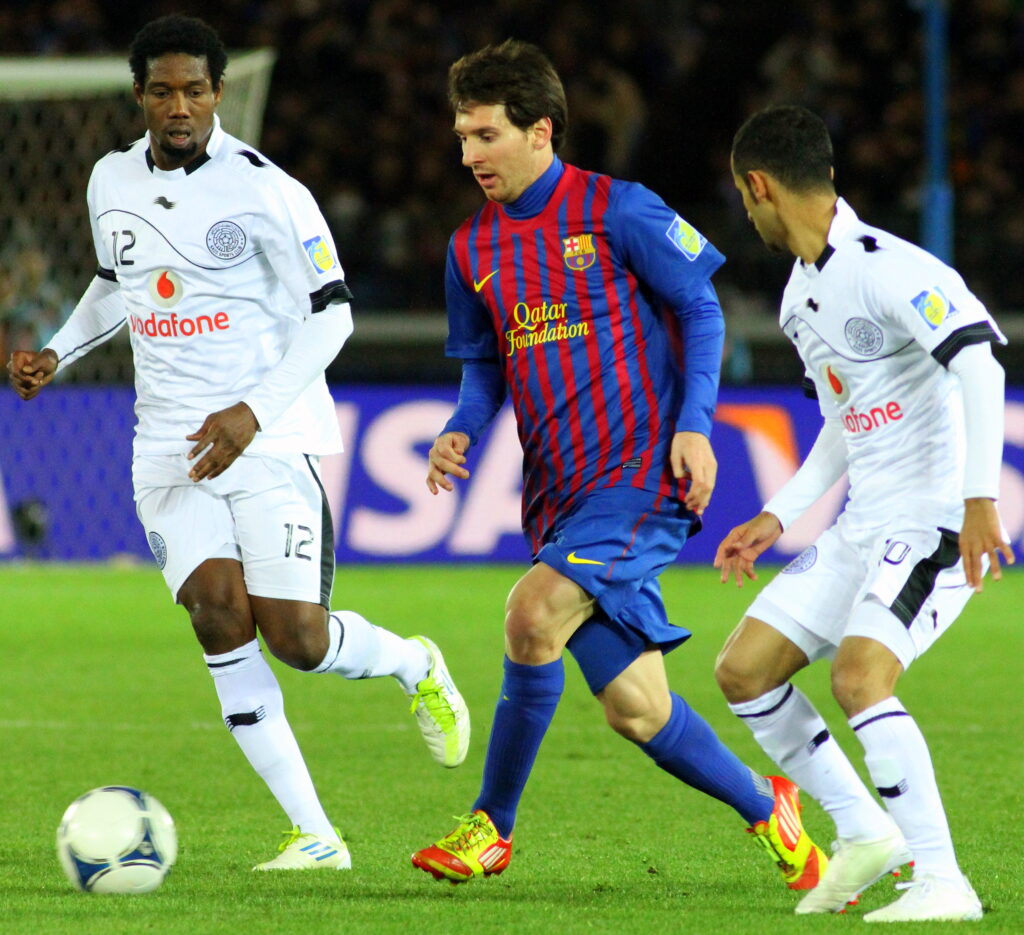 Lionel Messi with F.C. Barcelona during his Player of the Year season in 2011. Attribution: Christopher Johnson via Wikimedia Commons
Lionel Messi and Pep Guardiola
Pep Guardiola took charge of Barcelona’s first team in 2008 and began giving Messi new responsibilities. As UEFA’s study of his changing role explains, the right-sided attacker also became a “false nine”: a centre-forward who dropped towards midfield. Should a defender follow him or stay back to protect the goal? Either decision could leave room for Messi or a teammate to exploit.
The effect was spectacular at the Bernabéu on 2 May 2009. In Barcelona’s 6–2 league victory over Real Madrid, Messi and Thierry Henry scored twice each, with Carles Puyol and Piqué supplying the other goals. Messi could retreat to receive the ball, combine with the midfield and then reappear where Madrid least wanted him. The movement made his scoring and creativity feel like parts of the same continuous threat.
Later that month, he provided a very different finish on an even bigger occasion. Barcelona faced Manchester United in the Champions League final in Rome on 27 May. Samuel Eto’o gave them an early lead, and Messi met Xavi’s cross with a looping header in the 70th minute. The 2–0 victory completed a league, cup and European Cup treble. Three years after missing the final through injury, he had scored in the match that secured it.
Barcelona went on to win six trophies during the 2009 calendar year. Messi also received his first Ballon d’Or, the beginning of four consecutive wins from 2009 to 2012. His success was becoming sustained rather than occasional, with new versions of the same challenge arriving for defenders every week.
Manchester United encountered him again in the Champions League final at Wembley on 28 May 2011. Pedro and Wayne Rooney had scored before Messi struck from outside the penalty area in the second half, giving Barcelona a lead they would keep. David Villa added a superb third in a 3–1 victory. With Xavi and Andrés Iniesta helping Barcelona control possession, Messi could take part in the patient combinations and still provide the sharpest finish. It is a match worth revisiting if you want to see how comfortably his individual brilliance fitted into that collective football.
Then came a year in which even following the numbers became an event. Messi scored 91 goals during the 2012 calendar year: 79 in official Barcelona matches and 12 for Argentina, including senior internationals outside competitive tournaments. That is a calendar-year figure, not a single league season. His league scoring was exceptional too: 50 La Liga goals in 2011/12. The pleasure was in the variety within those totals, from close combinations to sudden runs and finishes that gave a goalkeeper very little time to respond.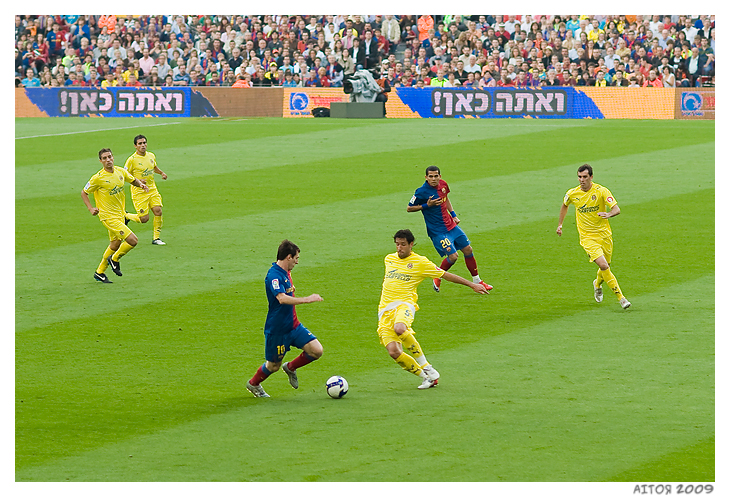 Messi against Villarreal on 10 May 2009, during Pep Guardiola’s first season as Barcelona coach. Photograph: Aitor Escauriaza, Messi, CC BY 2.0.
New partnerships and another treble
Guardiola’s departure in 2012 did not end Messi’s development. Under subsequent coaches, Barcelona had to find new combinations and manage periods affected by injury. A particularly successful adjustment came with Luis Enrique, who took charge in 2014. With Luis Suárez through the centre and Neymar on the left, Messi returned more often to the right, free to move inside and supply the other two as well as pursue goals himself.
With Suárez making runs through the middle and Neymar threatening on the other side, Messi had two excellent outlets for his passing. The three could share the goals, and the enjoyment of watching them came from seeing how readily they found one another.
One of his finest evenings came against Guardiola’s Bayern Munich on 6 May 2015. The Champions League semi-final first leg remained goalless until Messi beat Manuel Neuer in the 77th minute. Three minutes later, he changed direction in front of Jérôme Boateng and lifted a right-footed finish over the goalkeeper. He then supplied Neymar for Barcelona’s third. UEFA’s report of the 3–0 victory captures an evening transformed by a remarkable late burst.
Barcelona reached the final in Berlin, where Juventus provided stubborn opposition on 6 June. Ivan Rakitić opened the scoring, Álvaro Morata equalised, and the decisive second Barcelona goal began with a Messi shot that Gianluigi Buffon could only parry. Suárez followed it in, before Neymar completed the 3–1 win. For the second time, Messi and his teammates could celebrate winning the league, Copa del Rey and Champions League in the same season.
The goals continued in the seasons that followed. In 2018/19, Messi scored 36 times in La Liga and earned his sixth European Golden Shoe. At the October 2019 presentation reported by Barcelona, he said: “Without my team-mates I wouldn’t have scored any goals, this is for everyone, it’s a recognition for the whole team.” It was a generous way to receive an individual award, and an apt description of the partnerships that had helped make his scoring possible.
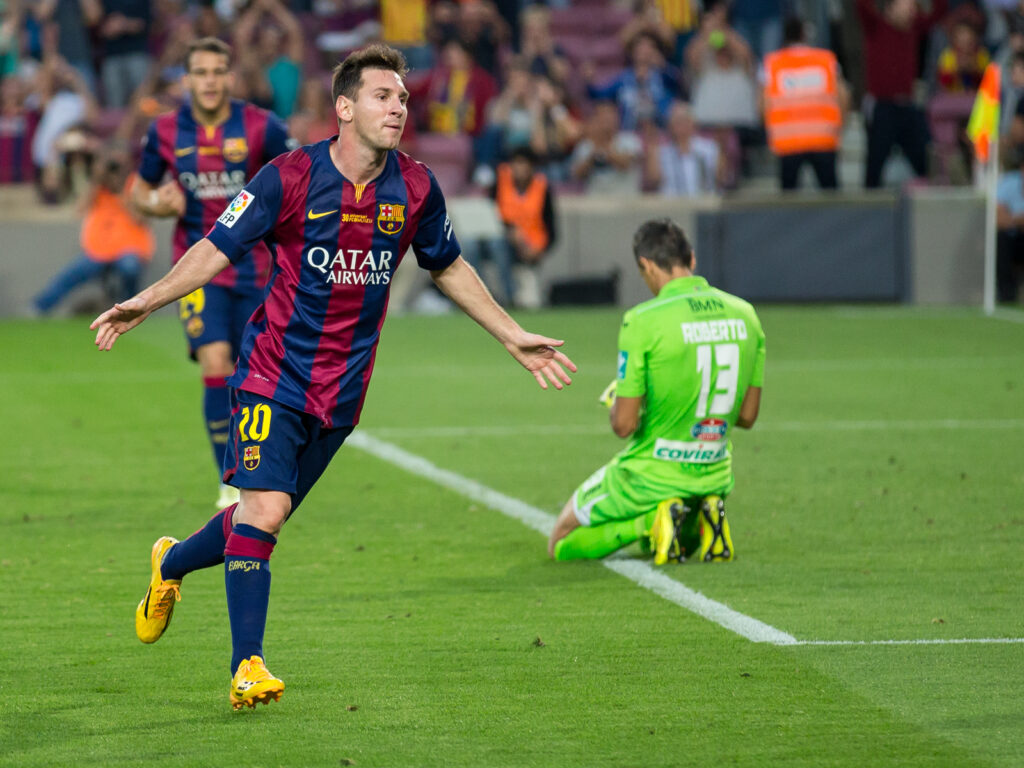 Lionel Messi with F.C. Barcelona celebrates after scoring a goal during a game against Granada CF in October 2014. Attribution: L.F. Salas via Wikimedia Commons
Saying goodbye to Barcelona
For all those achievements, Messi’s later Barcelona years also contained some painful European nights. In May 2019, Liverpool won the second leg of their Champions League semi-final 4–0, overturning Barcelona’s advantage and ending their hopes of another final. Divock Origi and Georginio Wijnaldum scored twice each. Messi’s club could still win domestic honours, but the European dominance of the treble teams was proving difficult to recover.
In 2020, his relationship with the club reached the point where he wanted to leave, before confirming in a September interview with GOAL that he would stay. He still had one more major Barcelona celebration ahead of him. In the Copa del Rey final on 17 April 2021, he scored twice in a 4–0 win over Athletic Club, lifting the trophy as captain.
The following summer brought a departure under different circumstances. Messi and Barcelona had reached an agreement over a new contract, but the club announced on 5 August 2021 that financial and structural obstacles under La Liga’s registration rules prevented it from proceeding.
Messi’s reaction was far removed from a player casually looking for a new challenge. At his farewell press conference on 8 August 2021, he explained: “I was not prepared. I was convinced I was staying, at home, that’s what we wanted.” He was leaving the club he had joined as a boy, now with a family of his own.
His Barcelona record closed at 35 team honours, including ten league titles and four Champions Leagues. Those years are central to his place among our greatest forwards of all time, and they gave Barcelona supporters a remarkable collection of matches to treasure.
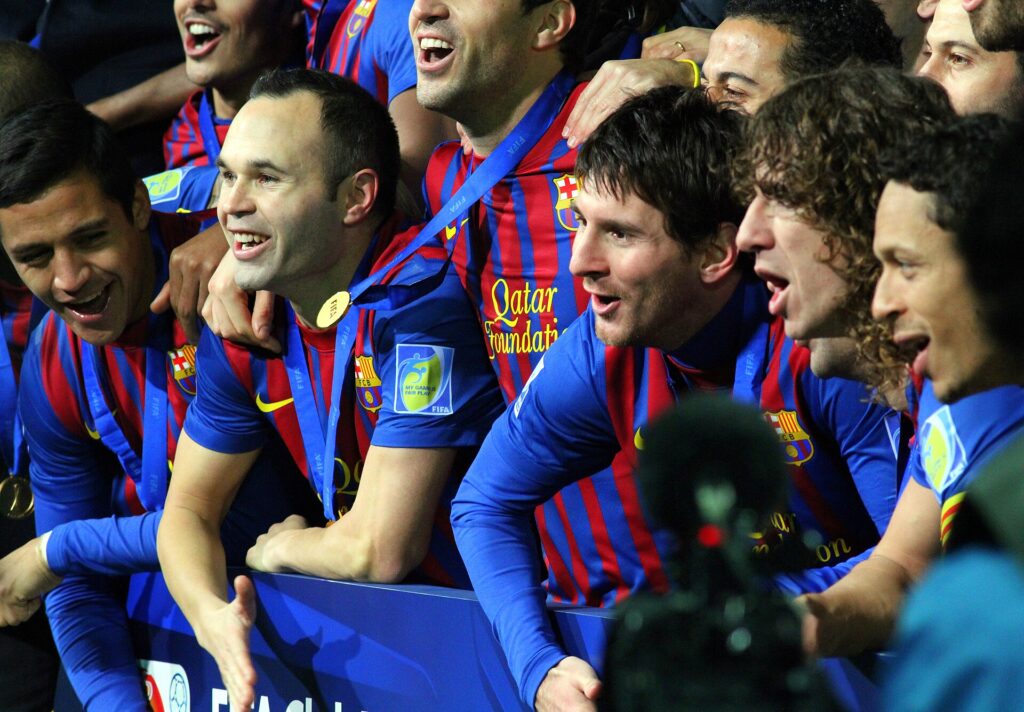 Club legends Lionel Messi, Iniesta, and Puyol with F.C. Barcelona after a victory in 2011. Attribution: Christopher Johnson via Wikimedia Commons
Lionel Messi’s Argentina story
While Messi was building that Barcelona career, his life with Argentina was following a parallel path. To understand why the later international victories mattered so much, we need to return to 2005, when he was still a teenager.
Messi helped Argentina win the Under-20 World Cup in the Netherlands, scoring six goals and receiving both the Golden Ball for the tournament’s best player and the Golden Boot as leading scorer. In the final against Nigeria, he converted two penalties in a 2–1 victory. FIFA’s account of the 2005 tournament records an early international success that accompanied his emergence at Barcelona.
He made his senior Argentina debut against Hungary in August 2005. The following summer brought his first World Cup, where he came off the bench and scored in the 6–0 group-stage win over Serbia and Montenegro on 16 June 2006. He was still 18. Argentina’s tournament ended against Germany on penalties, but the young forward had begun the World Cup story that would stretch across the next two decades.
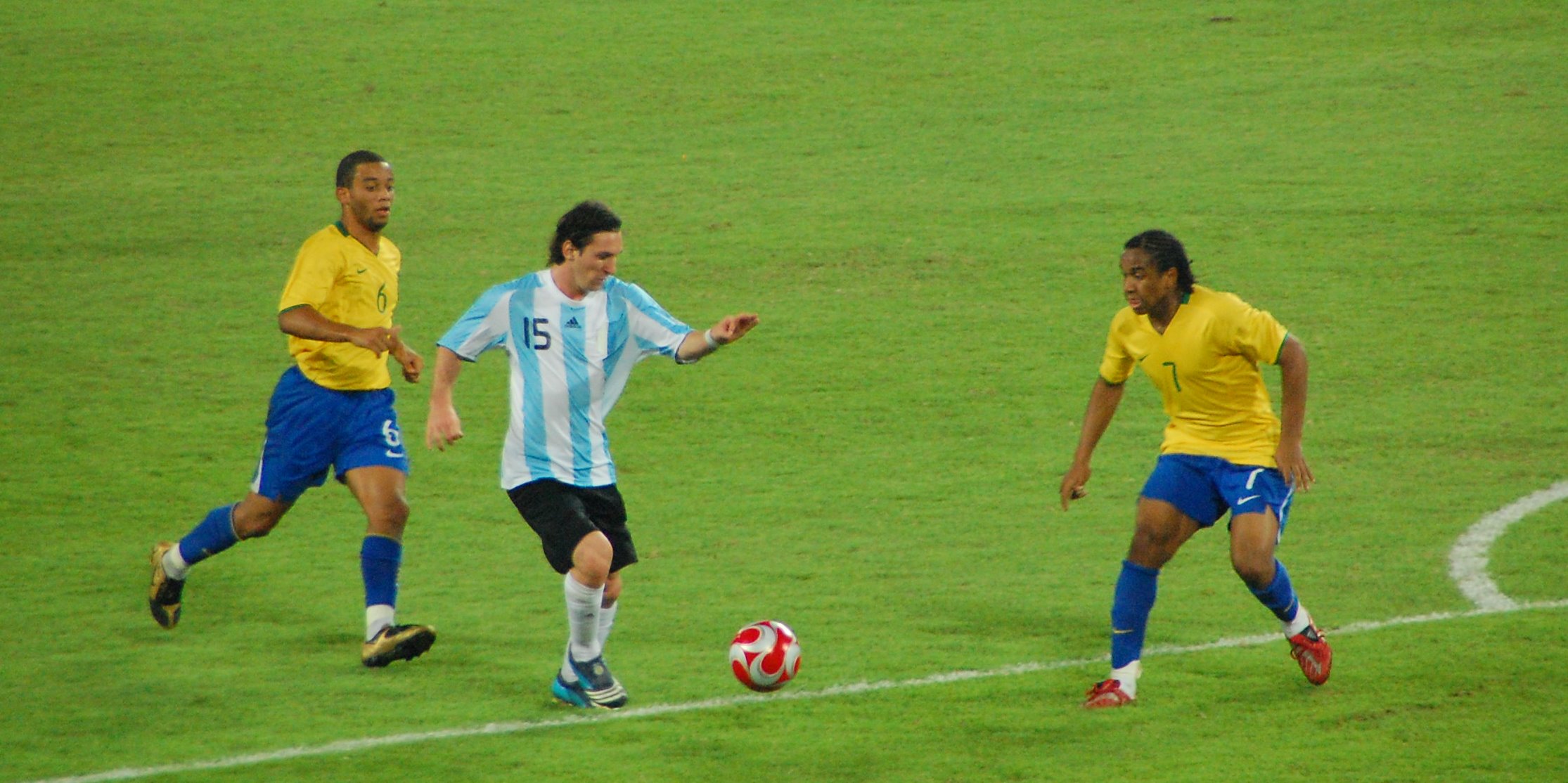
At the 2008 Olympics, he joined an Argentina team featuring Sergio Agüero, Javier Mascherano and Juan Román Riquelme. Against Nigeria in the Beijing final on 23 August, Messi released Ángel Di María, whose lifted finish secured a 1–0 win and the gold medal. In words recalled by FIFA’s August 2020 retrospective, Messi said: “Winning the gold medal was a dream of mine – and now it’s come true. I’m so happy.” These were youth and Olympic achievements, distinct from the senior international trophy he would wait much longer to win.
At the 2010 World Cup, Messi played under Diego Maradona, bringing Argentina’s two famous number tens together as player and coach. Germany again ended their tournament, this time with a 4–0 quarter-final win on 3 July. Four years later, Argentina reached the final in Brazil, where Mario Götze’s extra-time goal gave Germany a 1–0 victory. Messi received the 2014 Golden Ball as the tournament’s best player, but the team prize belonged to someone else.
Chile then defeated Argentina in successive Copa América finals. In the 2016 decider, reported by FIFA on 27 June, the sides finished goalless before Chile won the shoot-out 4–2. Messi sent his penalty over the bar. He announced his international retirement in the aftermath, before reversing that decision in August. His return statement, published by AS on 12 August 2016, explained the pull of his country and the Argentina shirt.
There would be another World Cup disappointment in 2018, when France won their last-16 meeting 4–3. However, under Lionel Scaloni, Argentina began to build a team in which Messi’s contribution was supported by a new generation of teammates. The breakthrough finally came in the 2021 Copa América, just before his Barcelona departure.
On 10 July, Argentina faced Brazil at the Maracanã. Di María scored the only goal, lifting the ball over Ederson, and Argentina held on for a 1–0 victory. As CONMEBOL’s account of the 2021 title explains, it ended a 28-year wait for the senior team to win the competition. For Messi, it brought the first senior international title of his career. After so many finals in which the celebration belonged to the other side, he could finally share this one with his Argentina teammates.
A new club in Paris
Following his Barcelona farewell in August 2021, Messi joined Paris Saint-Germain. He was reunited with Neymar and played alongside Kylian Mbappé, creating an attack with no shortage of talent. Mauricio Pochettino was the coach during his first season, and an early highlight arrived in the Champions League against Manchester City on 28 September. Messi scored in a 2–0 PSG victory, bringing a familiar kind of European excitement to his new surroundings.
The Champions League ambition remained unfulfilled, though. Real Madrid eliminated PSG in the 2022 last 16 after Karim Benzema’s second-leg hat-trick. Domestically, Messi would win the French league in both of his Paris seasons. Ligue 1’s review of his goals records 22 league goals across his 2021–23 spell.
With Argentina, meanwhile, the confidence from the Copa América continued. On 1 June 2022, Messi was named Player of the Match in the Finalissima, as the South American champions beat European champions Italy 3–0 at Wembley. Later that year, attention turned to Qatar and another opportunity at the World Cup.
 Lionel Messi playing for PSG against Olympique de Marseille on October 24th 2021 at the Stade Velodrome. Attribution: Bigmatbasket via Wikimedia Commons
Lionel Messi becomes a World Cup winner
Argentina’s 2022 World Cup began with a shock. Saudi Arabia beat them 2–1 on 22 November, despite Messi’s opening penalty. Against Mexico four days later, the next goal carried considerable weight. Messi found it with a low shot from outside the penalty area, before Enzo Fernández completed a 2–0 victory. AFA’s record of Argentina’s seven matches follows the recovery from that opening defeat.
Argentina progressed, and Messi kept contributing. He scored against Australia in the last 16, converted a penalty against the Netherlands in a quarter-final eventually settled by a shoot-out, and opened the scoring from the spot against Croatia in the semi-final. Julián Álvarez added two more in that 3–0 win. The team had reached the final, with Messi offering both experience and a continuing supply of decisive actions.
What followed against France on 18 December was enough to keep you watching every second. Messi scored a penalty in the 23rd minute, and Di María finished a flowing move to make it 2–0. Argentina seemed to have control until Mbappé scored twice in quick succession late in normal time. Suddenly, a final that had looked almost settled needed extra time. FIFA’s official match report records the extraordinary sequence.
Messi scored again in the 108th minute, following the ball in at close range. Mbappé answered with another penalty, completing his hat-trick and making the score 3–3. In the shoot-out, Messi converted Argentina’s first kick. Emiliano Martínez saved from Kingsley Coman, Aurélien Tchouaméni missed, and Gonzalo Montiel scored the penalty that secured a 4–2 shoot-out win. The Sky Sports report of the final, published in December 2022, brings together those exhausting changes of fortune.
At 35, Lionel Messi was a World Cup winner. He finished the tournament with seven goals and another Golden Ball, but there was now a team trophy to accompany the individual recognition. Reflecting after the final, in remarks published by The Indian Express on 19 December 2022, he said: “It took so long, but here it is. We suffered a lot, but we managed to do it.” Those words give the celebration its history: the achievement belonged to a player and a group who knew what it was to fall short.
The victory also adds a fascinating chapter to our greatest World Cup players of all time discussion. For Messi’s supporters, however, the immediate pleasure was simpler. The captain finally had the cup in his hands.
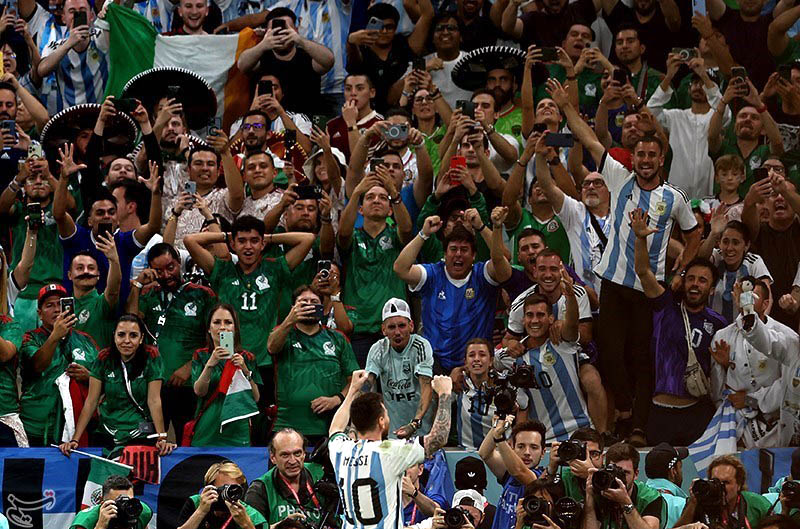
Photograph: Hossein Zohrevand / Tasnim News Agency, Argentina vs mexico messi celebra con tribuna, CC BY 4.0.
Lionel Messi joins Inter Miami
Messi returned to PSG after Qatar and completed his second French title-winning season. Bayern Munich ended the club’s 2022/23 Champions League campaign in the last 16, winning 3–0 on aggregate. His next move would take him away from European club football.
There had been an attraction in going back to Barcelona. Looking back in his December 2023 interview with TIME, Messi explained: “My first option was to return to Barcelona, but it was not possible.” Instead, he chose Inter Miami, beginning a new chapter for himself and his family in the United States.
His Miami debut on 21 July 2023 could hardly have offered supporters a more enjoyable introduction. With a Leagues Cup match against Cruz Azul level at 1–1, Messi stood over a free-kick in stoppage time and curled it into the top corner. The 94th-minute winner secured a 2–1 victory. If you were wondering how quickly he could create a moment worth remembering in a new shirt, the answer arrived on his first evening.
The run continued all the way to the Leagues Cup final against Nashville on 19 August. Messi scored in a match that finished 1–1, and Miami won an unusually long shoot-out 10–9. Goalkeeper Drake Callender converted his own penalty and then saved from opposite number Elliot Panicco to secure the trophy. MLS’s final report tells the story of Miami’s first title, with Messi already at the centre of the club’s biggest occasion.
Later in 2023, he received his eighth Ballon d’Or. His winning years, from 2009 to 2023, span the young Barcelona attacker, the established club captain and the World Cup winner. By then, he was already giving a new set of supporters reasons to enjoy his football.
In 2024, Miami won the Supporters’ Shield, awarded for the best MLS regular-season record, with 74 points. Messi contributed 20 goals and 16 assists in 19 league appearances and was named MLS Most Valuable Player. The Shield and the MLS Cup are different prizes, and Miami’s first Cup triumph would follow in 2025.
Before that came an encounter with European opposition at the 2025 Club World Cup. Against Porto in Atlanta on 19 June, Messi curled in the free-kick that completed Miami’s 2–1 comeback victory. They reached the last 16, where his former club PSG won 4–0. Miami’s domestic season still had a much happier occasion in store.
Against Vancouver Whitecaps in the final on 6 December 2025, Messi supplied Rodrigo De Paul for the goal that restored Miami’s lead, then set up Tadeo Allende to complete a 3–1 victory. It was another major final shaped by his passing. Former Barcelona teammates Sergio Busquets and Jordi Alba finished their playing careers with the celebration, giving the occasion a personal connection to the football they had shared years earlier.
Messi also became the first player to win the MLS MVP award in consecutive seasons. His 2025 regular-season figures were 29 goals and 19 assists in 28 appearances, with the goals earning the league’s Golden Boot. There was still plenty of competitive purpose behind the move to Miami.
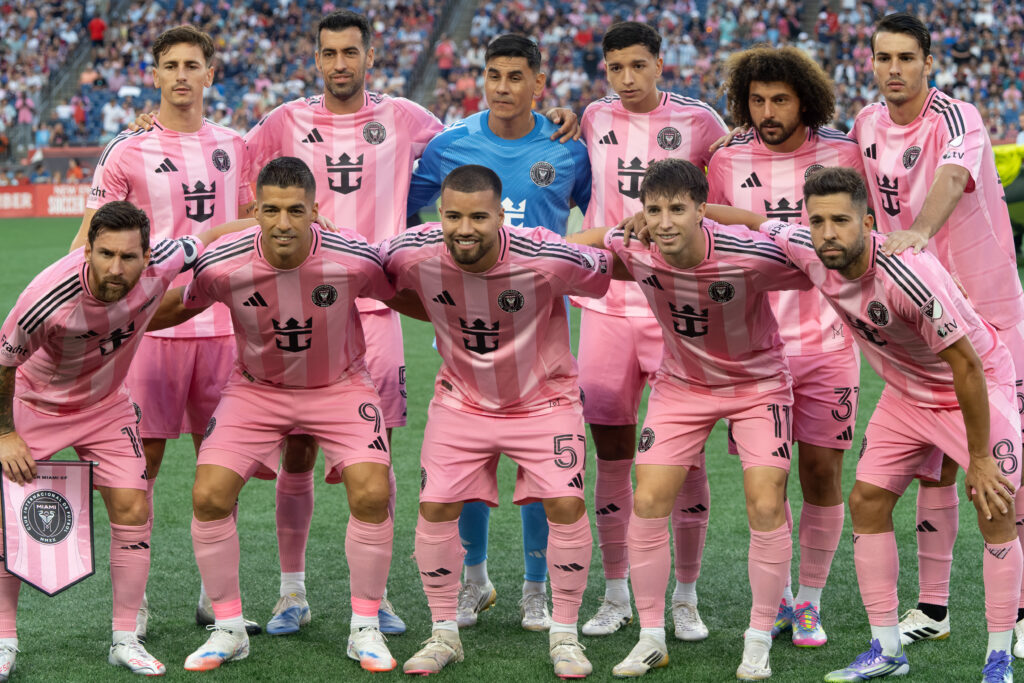 Inter Miami Starting XI during New England Revolution vs Inter Miami on July 9, 2025. Attribution: WikiPortraits Initiative via Wikimedia Commons
Argentina’s later triumph and final farewell
Alongside those Miami seasons, Messi continued to play for Argentina. At the 2024 Copa América, the holders reached another final, this time against Colombia in Miami Gardens on 14 July. Messi had to leave the pitch with an injury during the second half. His teammates carried the match through extra time, when Lautaro Martínez scored the goal that secured a 1–0 victory and another Copa América title.
The planned 2026 Finalissima against Spain was cancelled, but Messi did take part in that year’s World Cup. It was his sixth edition of the tournament, and he helped Argentina reach another final. According to Inter Miami’s report on its World Cup representatives, he played eight matches, scored eight goals and provided four assists. His tournament included a hat-trick against Algeria in the opening match and two goals against Austria. These were substantial contributions from a player who turned 39 during the competition.
This time the final brought disappointment. On 19 July 2026, Spain beat Argentina 1–0 after extra time, with Ferran Torres scoring the winner. Argentina’s attempt to retain the trophy had ended one match short.
On 31 August, Messi announced his retirement from international football. AFA published his farewell letter, which he had written on 21 July, shortly after the final. In the English wording published by CONMEBOL on 1 September 2026, he explained: “It was a decision that hurt and still hurts deep inside, but I understand that this is the right time.” It brought the Argentina chapter to a close after the long pursuit of a senior title, the joy of winning it and a final World Cup campaign.
His club career continues. As of September 2026, Messi remains an Inter Miami player, having extended his contract through 2028. On 9 September he captained Miami in a 1–1 draw at Chicago Fire, supplying the corner from which Casemiro scored. The international farewell has not removed him from the football pitch.
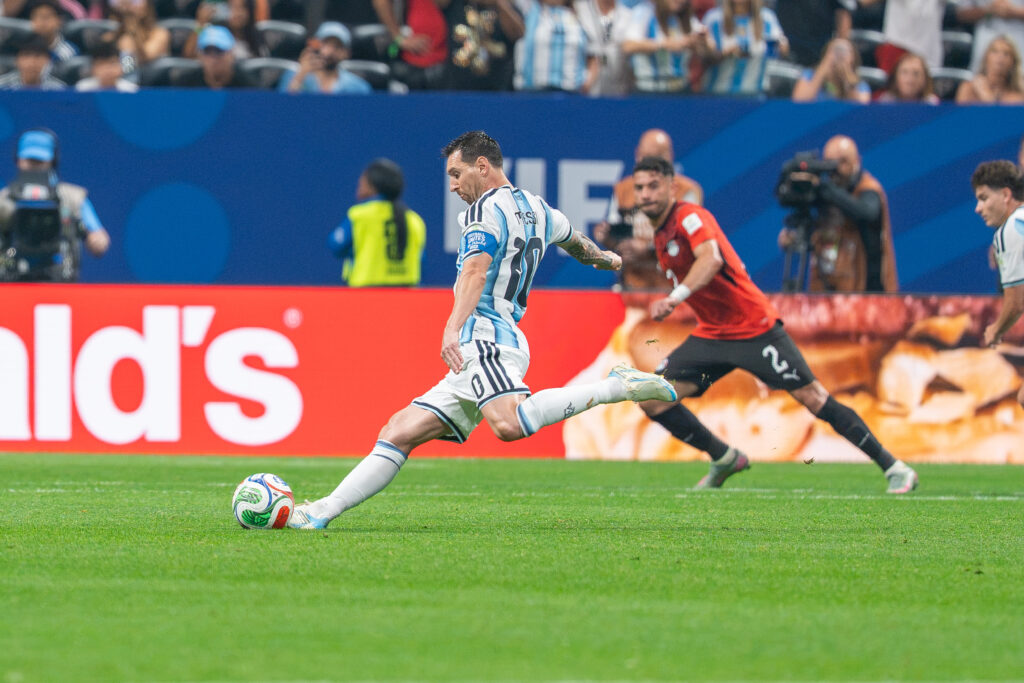 Lionel Messi during Argentina v Egypt at the 2026 FIFA World Cup. Attribution: Berlination via Wikimedia Commons
Lionel Messi away from football
For someone whose working life attracts so much attention, Messi has often described the appeal of a fairly ordinary family routine. He and his wife, Antonella Roccuzzo, have three sons, Thiago, Mateo and Ciro. In his September 2023 conversation with Migue Granados, reported by TN, he spoke about taking the children to school, going to training, having lunch with Antonella and spending time at home. It is a welcome view of the person between the fixtures, with the familiar pleasures and commitments of family life.
His public work for children extends beyond his own household. Messi became a UNICEF Goodwill Ambassador in March 2010, supporting the organisation’s work for children’s rights. A particularly concrete example came in 2017, when the Leo Messi Foundation helped UNICEF install 20 prefabricated classrooms in Syria. UNICEF’s May 2017 announcement said the classrooms would benefit more than 1,600 children affected by the conflict. The project provided somewhere for lessons to take place, giving the charitable work a purpose you can readily picture.
If you would like to keep following Lionel Messi, his official website and Inter Miami’s Messi news page are useful places to stay connected. And if this biography has tempted you to revisit an earlier performance, try the 2011 Champions League final or that unforgettable first evening with Miami. There is a special pleasure in knowing a wonderful piece of football is coming and watching it happen all over again.
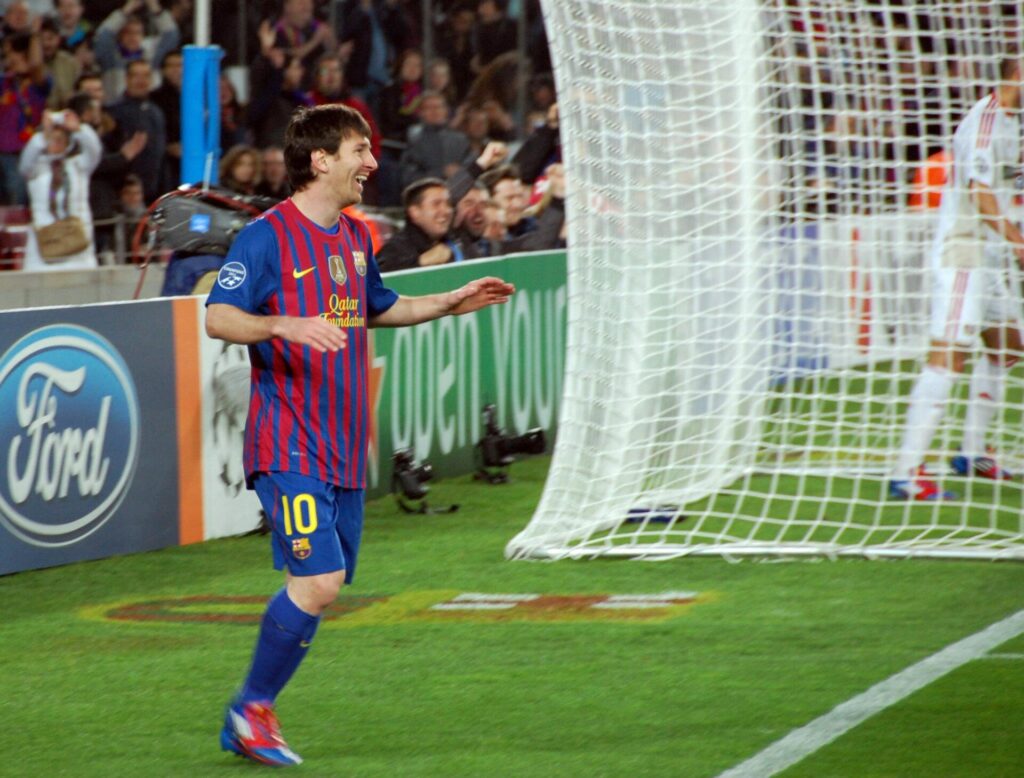 FC Barcelona – Bayer 04 Leverkusen, 1/8 Final UEFA Champions League, Season 2011/2012. Attribution: Shai Pal via Wikimedia Commons




.jpg)